

Information
Welcome

On behalf of ISHS and ISPP we invite you to the VIII International symposium on postharvest plant pathology: Plant to Plate - Integrated and innovative approaches for managing postharvest disease across the supply chain.
The symposium will put focus on the holistic nature of postharvest pathology with strong relationships between growing of the crop, storage technology, and the influence of both pre- and post-harvest factors on the pathogen.
The symposium venue is the fjord district of western Norway within the heart of fruit growing in Norway. The event is scheduled during typical apple bloom, May 18th to 22nd 2026. We will ensure an engaging event with updates on the latest science within the framework of a picturesque landscape and an elegant conference hotel.
LATEST NEWS
17.04.2026: Shuttle bus and guest payment info added
06.03.2026: Information to presenters
11.02.2026 More program details added
07.01.2026: New keynote speaker
Important dates
Abstract submission open: September 1st 2025
NEW Deadline for abstract submission: January 15th 2026
Notification of abstract acceptance: February 1st 2026
Full paper submission deadline: May 25th 2026
Registration opens: October 21st 2025
Registration closes: February 15th 2026
Invited speakers
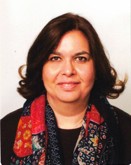 |
Prof. Simona Marianna Sanzani graduated in Biology in 2002 and obtained her PhD in Plant Protection in 2008 at University of Bari Aldo Moro, where she also completed her MSc in Postharvest Management of Fresh Fruit and Vegetables. Her studies, as associate professor in Plant pathology at the Dept. of Soil, Plant and Food Sciences of the University of Bari Aldo Moro (Italy), focus on the molecular detection and alternative control of fungal pathogens both in the field and after harvest using conventional and molecular approaches, with particular attention to prevention and control of mycotoxigenic fungi and related mycotoxins. | |
| She has authored or co-authored 92 peer-reviewed, ISI-indexed publications on various aspects of plant pathology, mycology and microbiology (Hi 31), written 16 book chapters, coordinated the publication of 1 book, and attended as invited speaker several International Congresses. She is Associated Editor of “European Journal of Plant Pathology” and Senior Editor of “Journal of Plant Pathology”. She is the PI of national and international projects and attended as visiting researcher the Katholieke Universiteit Leuven (Belgium), the Instituto de Agroquímica y Tecnología de Alimentos (Valencia, Spain), and the Sapienza University of Rome (Italy). Simona will have keynote: A farm-to-fork sustainable approach to increase safety and reduce postharvest losses of fresh fruits and vegetables | ||
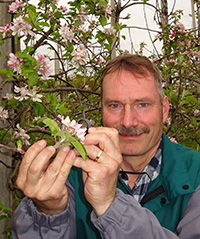 . . |
Prof. Roland Weber, is Head of the Dept. of Crop Protection at the Esteburg Centre in Germany which provides research and consultancy to the Lower Elbe region, Northern Europe’s largest fruit production area. He is also Affiliated Professor at the Dept. of Food Science, Aarhus University, Denmark. Roland has a whole-organism approach to his favourite discipline, mycology, and has worked on a wide range of topics including ecophysiology, biochemistry and plant pathology. During the past 20 years his research work has focused on the infection biology and control of fruit-pathogenic fungi. Topics have included fungicide resistance issues in Botrytis on strawberries and other fruit crops and in Venturia on apple, the occurrence and spread of new pathogens, the infection biology and control of fungal storage rots of apples, and apple canker. |
| His research covers both IPM and organic production systems. Roland received his B.Sc. and Ph.D. degrees from the University of Exeter, U.K. Following prolonged periods of research and teaching at Exeter and Kaiserslautern, he joined the Esteburg Centre in 2006. He has published 128 peer-reviewed articles, 15 book chapters and some 185 contributions to journals in applied fruit production. He is co-author of the internationally renowned textbook Introduction to Fungi (Webster & Weber, 2007). Roland will provide the keynote: Apple storage diseases and control options in commercial fruit production in Northern Germany: a holistic overview. | |
 . . |
||
|
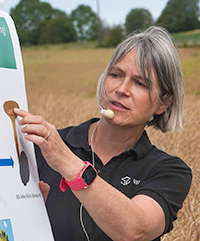
She has been senior editor for the APS journal Plant Disease and associate editor for the European Journal of Plant Pathology. Her international network spans across the globe as she is an active and engaged member within the InternationaI Society of Plant Pathology (ISPP), the European Plant Science Organization, the European Foundation of Plant Pathology (EFPP), the American Phytopathological Society, the Nordic Association of Agricultural Sciences (NJF) and the Nordic Baltic Resistance Action Group (NorBaRAG). Andrea will provide the keynote: Sensor technology to detect, monitor and manage pathogens during transport and storage. |
||
|
|
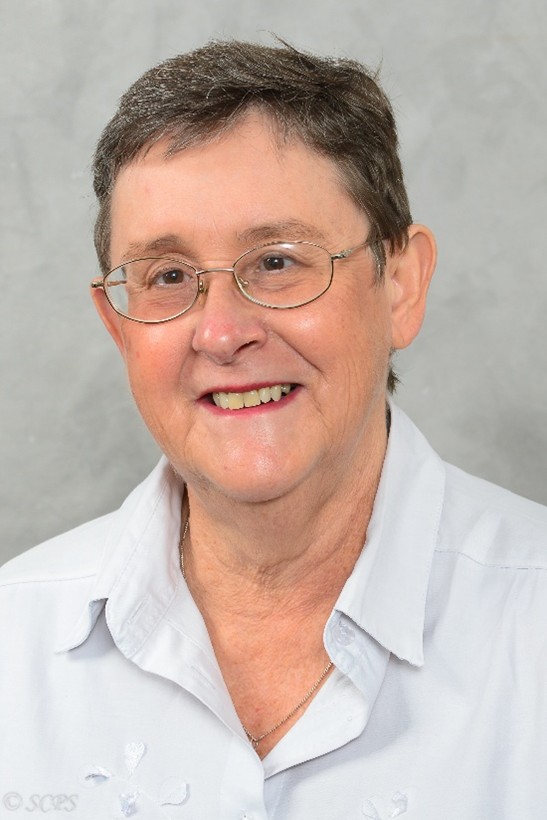
Dr. Cheryl Lennox is a chairperson and senior lecturer in the Department of Plant Pathology at Stellenbosch University in South Africa. She is also a senior lecturer in the department, focusing on integrated plant disease management and postharvest disease management. In 2008, she established the Fruit and Postharvest Pathology Research Program within the Plant Pathology Department. Through her work, she has supervised many Masters and PhD students in research topics related to etiology and management of pre- and post-harvest diseases of fruit crops. In addition, she is the current president of the Southern African Society for Plant Pathology (SASPP). Cheryl will have the keynote: Significant challenges and opportunities in managing postharvest diseases of export fruit to long-distance destinations. |
|
 ..
..
Scientific committee
Kari Peters
Kerry Everett
Gianfranco Romanazzi
Samir Droby
Cheryl Lennox
Belachew Asalf Tadesse
Arne Stensvand
Jorunn Børve
We hope to see you all there
Jorunn Børve
-convener
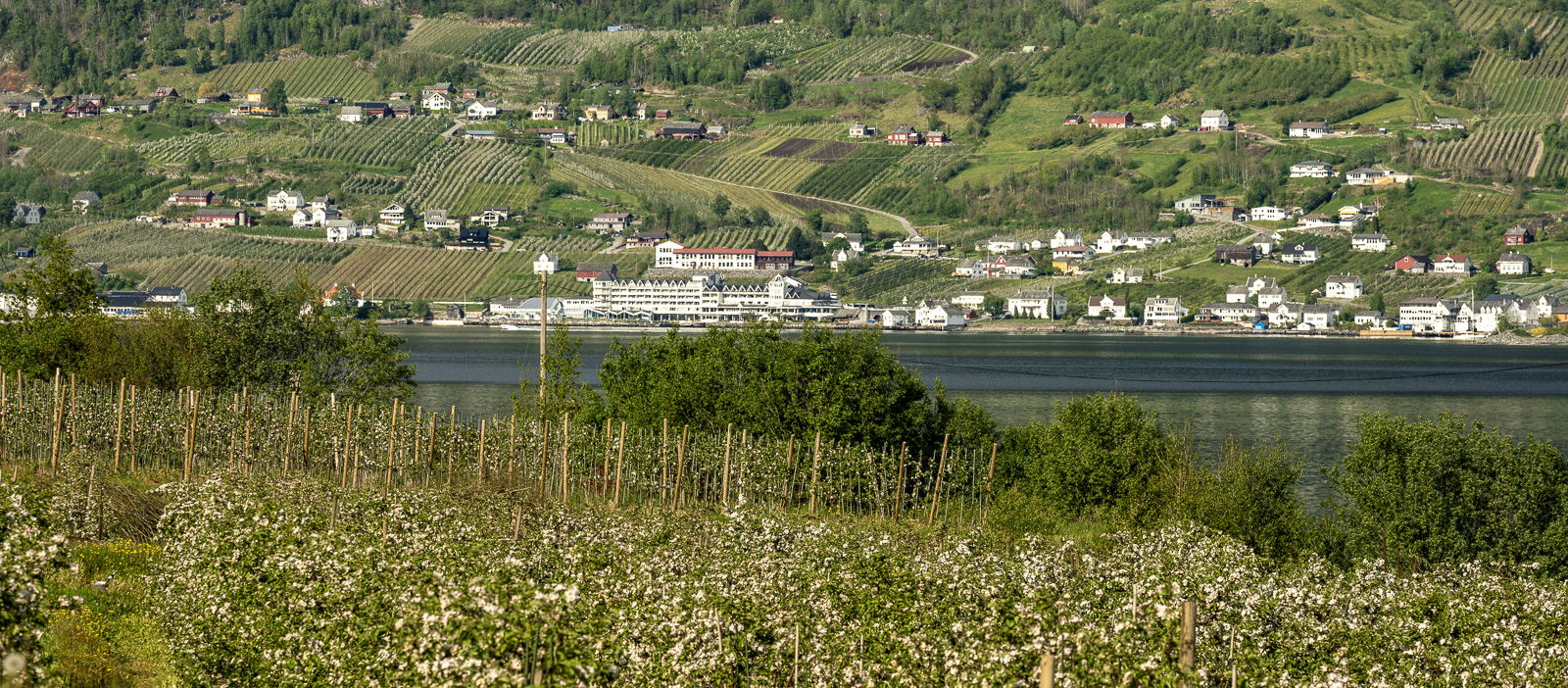
The symposium venue will be Hotel Ullensvang situated in the fjord district of western Norway within the heart of fruit growing in Norway. The event is scheduled during typical apple bloom, May 18th to 22nd 2026. We will ensure an engaging event with updates on the latest science within the framework of a picturesque landscape and an elegant conference hotel.
Sponsors:




Registration
Registration options
As this is a “destination” conference in a small village (population ~600 people), some features are different than at many other conferences. We advise you to read through the information carefully before registering. There is no early bird registration, but we advise people to still register early as there is limited space. Registration fees must be paid once you submit the form at the bottom of this page. Allergies or other food restrictions must also be provided when registering.
Practical information about the conference hotel
The conference venue is at the hotel (Hotel Ullensvang), which is providing special room rates for conference attendants. You must decide at registration if you will stay at the conference hotel or externally (see below for more info) to secure these rates. It is not possible to book via the hotel website or third-party websites. Costs for staying at the hotel are not included in the registration, and the bill will be paid directly at check-out. It is not possible to get an invoice for hotel stays.
Hotel room rates (paid at check-out from the hotel)
Accommodation rates include a warm buffet breakfast.
Single room: NOK 1590.- per night
Double room: NOK 2500.- per night
Family room (1 queen bed and 2 bunk beds, 4 people total): NOK 2500.- per night. There are only 10 family rooms available, so we advise booking early. Children 0-2 stay for free, breakfast included. Each child from ages 3-12 stays for an additional NOK 300.- per night, including breakfast. Children 13 and older stay for an additional NOK 600.- per night, including breakfast. If needed, a crib/child’s bed for children 0-2 can be added for NOK 300.- per night.
Swimming at the hotel pools / sauna use is included for free for all guests (non-guests can access the pools after payment).
Alternative accommodation
Other accommodation can be found in the area, although there are no other hotels in town. There are many Airbnb’s, which are very popular and should be booked early. In addition, there is a B&B (https://www.ullensvang-gjesteheim.no/en/) and a camping spot with small cabins for rent (https://lofthuscamping.com/). It is important to note that conference participants not staying at the hotel will have to pay extra at registration for lunch and the meeting facilities - see fee alternatives.
Dinner options
The hotel would like to know in advance how many people will be attending dinner each night (a buffet dinner from 18:00 to 21:30). Therefore, there is an option below to indicate which nights you are interested in having dinner (this is non-binding). Cost of dinner will be added to your room tab each night if staying at hotel (to be paid at check-out), or is payable at the entrance to the dinner buffet if you will not be a guest at the hotel.
Conference attendees staying at the hotel pay NOK 550.- per dinner
Children 0-12 pay a combined NOK 600.- per day for lunch and dinner.
All others (conference attendees not staying at the hotel, non-participants, children 13 and older etc). pay NOK 695.- per dinner.
Lunch can also be provided for non-participants without prebooking, NOK 360.- per day.
There are some other alternatives for food in the village, see the “Venue, travel, and contact” page for more info.
Registration alternatives:
The registration fee to the organizer includes the welcome reception, online access to the Acta Horticulturae symposium proceedings, the excursion including lunch and symposium dinner in the area, coffee and tea breaks during the meeting, and lunch at the symposium hotel three days.
If staying at the symposium hotel:
ISHS member: NOK 9000.-
Non-ISHS member: NOK 10200.-
Student registration: NOK 5000.-
One day registration including lunch, excluding Acta Horticulturae: NOK 1200.-
If not staying at the symposium hotel:
ISHS member: NOK 9500.-
Non-ISHS member: NOK 10700.-
Student registration: NOK 5500.-
One day attendance including lunch, excluding Acta Horticulturae: NOK 1500.-
Half day attendance excl. lunch, excluding Acta Horticulturae: NOK 500.-
If you are traveling with someone who will not attend the full conference, they are welcome to attend the welcome reception, the field trip and dinner on Wednesday, as well as the post-symposium tour. Costs for attending the welcome session only are NOK 300. The field trip and dinner cost NOK 1400. The post-symposium tour is the same costs for everybody. Please indicate in the comment section which events, if any, the extra guests will attend. Details for how to pay will be communicated later.
Additional meeting rooms during the symposium can be rented, contact the organizer at isphpp2026@nibio.no
Post symposium tour:
A post symposium tour will be organized if enough people are interested. You need to express interest by sending an email to the conference e-mail address: isphpp2026@nibio.no by February 15 th, and state whether you are interested in going to a fruit packinghouse and orchard or vegetable (onion and potato) packinghouses.
Approx cost:
2-3000 NOK per person in single rooms or 1500-2500 NOK per person in double rooms. Final price is dependent on the total number of participants and will be calculated according to the number of buses needed.
Price includes: bus transport to Bø, dinner Friday evening in Bø, and hotel stay with breakfast in Bø, minibus to packinghouse/orchard in Bø-area or minibus to Larvik/Lågendalen to visit the vegetable or potato packinghouses.
The tour ends at the railway stations in either Bø or Larvik which has direct trains to Oslo/airport Gardermoen. It is possible to arrange group train tickets for the group to Oslo-Gardermoen if enough people are interested.
Information
This activity has ended, and it is no longer possible to register.
Sponsors:
Program
"For a detailed conference program including abstracts, please use the Whova conference app/website, or use this link."
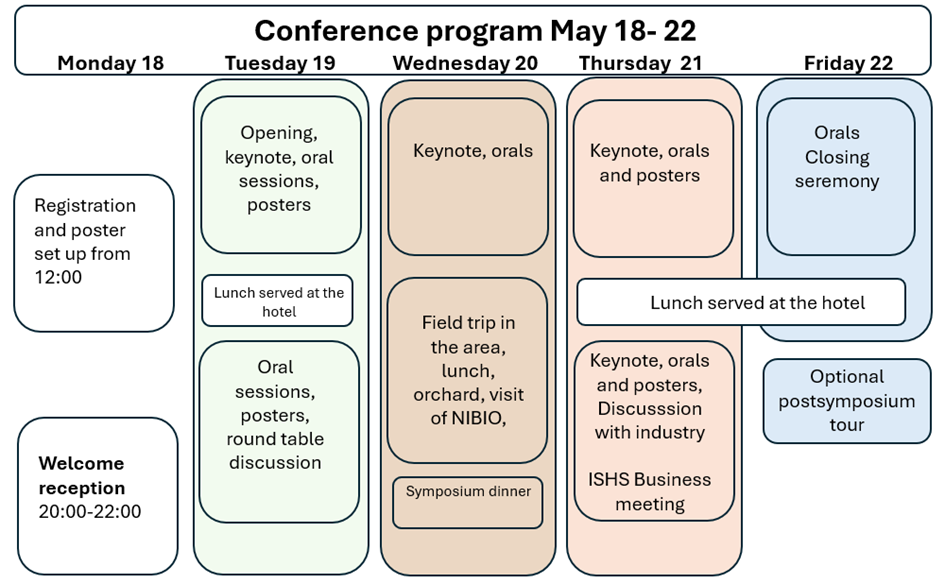
| Detailed conference program | |||
| Monday 18.5 | |||
| 20:00 | Welcome reception | ||
| Tuesday 19.5 | |||
| 08:30 | Welcoming session | ||
| 08:45 | Keynote 1 | Simona M. Sanzani | A farm-to-fork sustainable approach to increase safety and reduce postharvest losses of fresh fruits and vegetables |
| Session 1: Microbiome applications. Session organizers: Dalphy O.C. Harteveld and Andreas Bühlmann | |||
| 09:15 | Oral 1.1 | Davide Spadaro | Air and fruit microbiomes are powerful tools to investigate the epidemiology of apple postharvest latent pathogens |
| 09:30 | Oral 1.2 | Kerry Everett | Microbiome of apple lenticels and skin from orchards with high and low incidence of Phlyctema vagabunda |
| 09:45 | Oral 1.3 | Boqiang Li | Isolation of new biocontrol agents based on microbiome analysis of postharvest fruit |
| 10:00 | Oral 1.4 | Leonardo Schena | Engineering Resilient Microbial Communities to Control Postharvest disease |
| 10:15 | Discussion | ||
| Session 2: Identification of fungal pathogens. Session organizers: Cheryl Lennox and Belachew Asalf Tadesse | |||
| 10:30 | Poster-coffee break | ||
| Poster 2.1 | Tebogo Marutha | The eitiology of bitter rot of apple in the Western Cape | |
| Poster 2.2 | Dalphy O. C. Harteveld | Molecular identification of Ramularia species associated with postharvest spots on apple in Norway | |
| Poster 2.3 | Belachew Asalf Tadesse | Molecular diagnostics for early detection of fusarium basal rot caused by Fusarium oxysporum f. sp. cepae in onion | |
| Poster 2.4 | Alessio Bernasconi | Pathogen identification and management strategies for reducing storage rot in organic beetroot | |
| 11:00 | Oral 2.1 | Stefanie Maria Primisser | Dry lenticel rot in alpine apple production: A decade of insights into Ramularia mali |
| 11:15 | Oral 2.2 | Julia Meitz-Hopkins | Development of Diplodia seriata microsatellite markers for population genetic analysis |
| 11:30 | Oral 2.3 | Sanja Baric | High resolution melting (HRM) analysis for identifying fungal postharvest pathogens of apple |
| 11:45 | Oral 2.4 | Danielle Duanis-Assaf | Hidden Allies or Foes? Inter-Kingdom Dynamics Between VBNC Salmonella enterica and Botrytis cinerea Across the Postharvest Supply Chain |
| 12:00 | Discussion | ||
|
12:15
|
Lunch
|
||
| Session 3: Essential oils and beneficial fungi. Session organizers: Neus Teixidó and Gianfranco Romanazzi | |||
| 13:15 | Oral 3.1 | Fabio Gemma | Natural Postharvest Protection: Exploring Metschnikowia pulcherrima as a Biocontrol Agent in Strawberries |
| 13:30 | Oral 3.2 | Giulia Remolif | Optimization of a cost-effective culture medium for mass production of an endophytic antagonistic strain of Aureobasidium pullulans |
| 13:45 | Oral 3.3 | Gianfranco Romanazzi | Essential oils as potential basic substances for the control of postharvest decay of fresh strawberries |
| 14:00 | Oral 3.4 | Andreas Bühlmann | Metschnikowia pulcherrima as a biocontrol agent against Phlyctema vagabunda in postharvest of apple fruit |
| 14:15 | Oral 3.5 | Dario Angeli | The antifungal potential of essential oils on organic apples stored after harvest |
| 14:30 | Oral 3.6 | Daniel A. Neuwald | Application of hot water, calcium and essential oils for controlling postharvest rots of apple ‘Topaz’ in storage |
| 14:45 | Poster-coffee break | ||
| Poster 3.1 | Justina Griauzdaite | The propolis extracts as a bio-fungicide against raspberry grey mould | |
| Poster 3.2 | Ornella Incerti | Basidiomycetes as Eco-Friendly Biocontrol Agents Against Postharvest Fungal Pathogens | |
| Poster 3.3 | Giulia Remolif | Control of strawberry postharvest rots using antagonistic yeasts: effects on disease suppression, fruit quality and microbial communities | |
|
Poster 3.4
|
Johannes Gafriller
|
Microbial Allies: Harnessing Yeasts to Suppress Ramularia
|
|
| Session 4: Other biological alternatives. Session organizers: Kerry Everett and Davide Spadaro | |||
| 15:15 | Oral 4.1 | Noam Alkan | Antifungal Plant Peptide Infused into Minerals for Postharvest Disease Control |
| 15:30 | Oral 4.2 | Edward Sionov | Antifungal properties and mode of action of zinc chloride for postharvest control of toxigenic fungi |
| 15:45 | Oral 4.3 | McKenzie Schessl | Biological control of black rot disease using bacteriophage in controlled environment agriculture microgreen broccoli production |
| 16:00 | Oral 4.4 | Annamaria Mincuzzi | Postharvest diseases of pomegranates: integrated alternative control means |
| 16:15 | Oral 4.5 | Elizabeth van Rooyen | Potential effect of alternatives and synthetic fungicide treatments on heart rot in pomegranates |
| 16:30 | Oral 4.6 | Liliana Aragón | Methodology for the evaluation of products that control Botrytis cinerea in Blueberry fruits during postharvest handling |
| 16:45 | Oral 4.7 | Abdullah Al-Sadi | A hurdle biocontrol program for postharvest strawberry and tomato: combining Meyerozyma, Bacillus and phenolic botanicals against gray, black and aflatoxigenic rots |
| 17:00 | Poster-coffee break | ||
| Poster 4.1 | Justina Griauzdaite | Strawberry preharvest treatment with alternative plant protection products for postharvest decay | |
| Poster 4.2 | Marcos David Ferreira | Antimicrobial activity of free and β-cyclodextrin–encapsulated essential oils against postharvest pathogenic fungi and bacterial strains | |
| Poster 4.3 | Aniello Crescenzi | Preliminary results on the effects of a silicon-based product on postharvest fungal diseases and quality of strawberry cv. ‘Murano’ | |
| 17:30 | Round table discussion on biocontrol registration Discussion moderator: Gianfranco Romanazzi | ||
| Introduction: Isabelle Pinzauti Babrzyński Biocontrol faster access to the market: bottlenecks and opportunities | |||
| Wednesday 20.5 | |||
| Session 5: Mangement of storage diseases in apple. Session organizers: Séverine Gabioud Rebeaud and Arne Stensvand | |||
| 08:30 | Keynote 2 | Roland W. S. Weber | An overview of apple storage diseases and control options in commercial fruit production in Northern Germany. |
| 09:00 | Oral 5.1 | Riley Harding | Efficacy of OMRI-listed preharvest fungicides and alternative management practices for mitigating summer rots and postharvest decay of apple |
| 09:15 | Oral 5.2 | Séverine Gabioud Rebeaud | Evaluation of pre- and postharvest strategies for reducing fungal diseases during storage of organic apples |
| 09:30 | Oral 5.3 | Tebogo Marutha | Management of Fusarium spp. causing postharvest decay in apple |
| 09:45 | Oral 5.4 | Jorunn Børve | Bitter rot of apple in Norway |
| 10:00 | Coffee break | ||
| 10:15 | Oral 5.5 | An Ceustermans | Postharvest control of brown rot caused by Monilinia spp. and Neonectria storage rot |
| 10:30 | Oral 5.6 | Monica Walter | Rain dispersal of fungal conidia in different pipfruit canopies |
| 10:45 | Oral 5.7 | Kerry Everett | Inoculum quantification of Venturia inaequalis in apple orchards |
| 11:00 | Discussion | ||
| 12:00 | Field trip | ||
| 18:00 | Bus | ||
| 19:00 | Symposium dinner | ||
| Thursday 21.5 | |||
| Session 6: Combined technologies for optimal consumer quality Session organizers: Jorunn Børve and Antonio Ippoliti | |||
| 09:00 | Keynote 3 | Cheryl Lennox | Significant challenges and opportunities in managing postharvest diseases of export fruit to long-distance destinations |
| 09:30 | Oral 6.1 | Alessandra Di Francesco | Aureobasidium pullulans and its multiple potentials in biological control: pullulan production for postharvest fungal diseases management |
| 09:45 | Oral 6.2 | Samuel Köchli | Alternative plant protection strategies in fruit production and their impact on postharvest diseases |
| 10:00 | Oral 6.3 | Lluís Palou | Edible coatings containing antifungal plant extracts from agri-food waste to reduce Penicillium decay and preserve quality of ‘Valencia Late’ oranges during cold storage |
| 10:15 | Oral 6.4 | Adriana Lugaresi | Electrolyzed water against postharvest pathogens in apples |
| 10:30 | Coffee and posters | ||
| Poster 6.1 | Daniel A. Neuwald | Storage of yellow-fleshed kiwifruit under regular controlled atmosphere with complementary techniques and at extremely low oxygen | |
| Poster 6.2 | Kerry Everett | Integrated Biosecurity Risk Analysis Model (IBRAM-path) for estimating the risk of entry, establishment and spread of plant pathogens into new countries | |
| Poster 6.3 | Simona Marianna Sanzani | Active edible coatings to reduce postharvest rots of strawberries, cherry tomatoes, and blueberries | |
| Poster 6.4 | Aruppillai Suthaparan | Controlling postharvest rot using short wavelength UV in combination with cold storage in onion and carrot | |
| Poster 6.5 | Kata Ludman-Mihály | Effect of modified atmosphere packaging and chitosan combined treatment on the shelf life of Hungarian sour cherry cultivars | |
| Poster 6.6 | Wenjun Wang | The AbZnF-GATA Transcription Factor Mediates Pseudomonas B2-Induced Agaricus bisporus Browning via Regulating AbPPO1 and AbPPO2 | |
| Poster 6.7 | Antonio Ippolito | Isolation and characterization of Aspergillus and Penicillium spp. from cereals used in swine feeds in Apulia (Southern Italy) | |
| Poster 6.8 | Gianni Ceredi | Kiwifruit susceptibility to gray mold: Variety and plant growth regulators as potential conditioning factors | |
| Poster 6.9 | Dario Angeli | Preserving the quality of Torbole broccoli from harvest to retail: storage conditions and packaging techniques | |
| Poster 6.10 | Satu Hult | High tunnel soilless cultivation improves postharvest storage quality of american cranberry by decreasing fungal pathogen incidence | |
| 11:00 | Oral 6.5 | Neus Teixidó | Next-Generation of multifunctional products: integrated strategies for sustainable postharvest fruit quality management |
| 11:15 | Oral 6.6 | Fernanda de Candido de Oliveira | Evaluation of Emerging Postharvest Technologies in Apples: Impacts on Fruit Quality After Storage |
| 11:30 | Oral 6.7 | Kari Peter | Inoculum sources driving fungicide-resistant Penicillium spp. causing apple blue mold in the Mid-Atlantic United States |
| 11:45 | Oral 6.8 | Hanne Larsen | Impact of the EU Packaging and Packaging Waste Regulation (PPWR) on the fresh produce sector |
| 12:00 | Discussion | ||
| 12:30 | Lunch | ||
| Session 7: Sensors and fungal pathogens Session organizers: Daniel Alexandre Neuwald and Marcel Wenneker | |||
| 13:30 | Keynote 4 | Andrea Ficke | Sensor technology to detect monitor and manage pathogens during transport and storage |
| 14:00 | Oral 7.1 | Amandine Arnal | Characterisation of VOCs in apple–pathogen interaction: SIFT-MS analysis on Penicillium expansum and Phytophthora syringae during infection of Pink Lady |
| 14:15 | Oral 7.2 | Marcel Wenneker | Fungal Decay in ‘Conference’ Pears: The Role of 1-MCP and Volatile-Based Detection |
| 14:30 | Oral 7.3 | Najim El Harchioui | Dynamic near-freezing pear storage: temperature, NIR and HSI |
| 14:45 | Oral 7.4 | Dan Gamrasni | An innovative AI-driven approach for the development of environmentally friendly postharvest volatile fungicides |
| 15:00 | Oral 7.5 | Khadijah Ayarnah | Biosensor for rapid detection of latent fungi in fruits |
| 15:15 | Coffee and posters | ||
| Poster 7.1 | Antonio Ippolito | Portable sensor platforms for on-site rapid screening of agrifood safety and storability | |
| Poster 7.2 | Monica Walter | Simulating Apple Orchard Ecosystems | |
| Poster 7.3 | Sanja Baric | Assessing hyperspectral imaging for non destructive identification of postharvest pathogens of apple | |
| Poster 7.4 | Giancarlo Colelli | Spectral Information Combined with Physical Attributes, for the Prediction of Blackheart Defective Pomegranate fruit caused by Alternaria species | |
| Tunable | Demonstration of Einstein | ||
| 15:45 | Discussion | Discussion moderator: Andrea Ficke | |
| Introduction Tunable | |||
| Session 8: Molecular mechanisms and mycotoxins Session organizers: Kari Peter and Simona Sanzani | |||
| 16:30 | Oral 8.1 | Shiping Tian | The molecular mechanism of light signal regulating development and pathogenicity of Botrytis cinerea |
| 16:45 | Oral 8.2 | Kaifang Zeng | Mechanisms of induced resistance to green mold in citrus fruit by Pichia galeiformis and its secreted protein PgSCP |
| 17:00 | Oral 8.3 | Kaili Wang | The MdZAT11-MdHMGB10 Complex Positively Regulates Blue Mold Resistance in Apple |
| 17:15 | Oral 8.4 | Hongyin Zhang | PeAP1 and PeAtf1 play differential roles in Penicillium expansum virulence and patulin production |
| 17:30 | Oral 8.5 | Ornella Incerti | Molecular tools for the specific and rapid detection of toxigenic fungal contaminants in harvested commodities |
| 17:45 | Oral 8.6 | Carmit Ziv | Alternaria Black Mold in Sweet Pepper – Emerging Challenges and Implications for Food Waste and Safety |
| 18:00 | Discussion | ||
| 18:30 | Business meeting ISHS | ||
| Friday 22.5 | |||
| Session 9: Management of diseases in fruit, berry, herbs and vegetable crops. Session organizers: Alessio Bernasconi and Rishi R. Burlakoti | |||
| 08:30 | Oral 9.1 | Fauziah Tufail Ahmad | Innovative postharvest management of anthracnose in chili using natural antifungal agents |
| 08:45 | Oral 9.2 | Phenchan Whijitara | Shelf-Life Extension and Quality Retention in Fresh Centella asiatica for Minimizing Postharvest Loss |
| 09:00 | Oral 9.3 | Amit Raz Magid | Hidden threats: Preharvest viral infections determine postharvest quality of fresh produce |
| 09:15 | Oral 9.4 | Belachew Asalf Tadesse | Multi-Year Field Evaluation of Pythium Management Strategies and Post-Harvest Cavity Spot Progression in Carrots |
| 09:30 | Oral 9.5 | Merete Edelenbos | Causes of sour-soft rot following postharvest washing of snack carrots |
| 09:45 | Oral 9.6 | Qiya Yang | The mechanisms of Wickhamomyces anomalus in control of postharvest black spot disease in tomatoes and the preparation of its biocontrol solid products |
| 10:00 | Coffee and check out | ||
| 10:45 | Oral 9.7 | Rishi R. Burlakoti | Pathogen biology, epidemiology, and management of Botrytis fruit rot of berry crops in Canada |
| 11:00 | Oral 9.8 | Júlia Borràs-Bisa | Factors affecting sour rot development on stone fruit and cultivar susceptibility |
| 11:15 | Oral 9.9 | Ghofrane Zayati | Heat waves as a driver of physiological changes in Geotrichum candidum, the causal agent of sour rot in stone fruit |
| 11:30 | Discussion | ||
| 12:00 | Young minds award and closing of the symposium | ||
| 12:30 | Lunch | ||
| 14:00 | Post symposium tour | ||
May 17
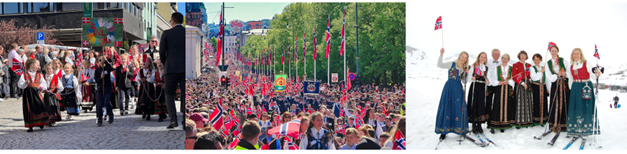
May 17 is the constitution day in Norway which is celebrated every year. We suggest you travel to Norway the day before and enjoy the celebration in either Bergen or Oslo. There will be big parades and a lot to explore.
In Lofthus there will be a celebration as well- at a smaller scale and at daytime focused around children. A party for the local community is normally organized in the evening with dance.
If you are eager on challenges we suggest joining the celebration of May 17 at Finse with a cross country ski trip on the glacier Hardangerjøkulen. Link to the event in 2025: https://www.dnt.no/hytter/betjente/finsehytta/arrangementer/172.-mai
Daytime May 18. Travel to Lofthus or enjoy the area (see folder venue and travel for alternatives and information)
Optional post-symposium tour (afternoon Friday – afternoon Saturday):
Leaving Friday 22nd after lunch, traveling to Bø (in Telemark, in the eastern part of Norway), having dinner and staying overnight at Bø hotel. There will be stops for sightseeing along the way (I.e. at waterfalls, on top of the mountain plateau, in mountain valleys).
Saturday 23rd: Two options
Option 1: Fruit. Visit to a fruit packinghouse where we will get a tour of the facilities, hopefully see some apples being packed, and have some discussions about fungal issues they experience. After a provided lunch, we will continue on to a local orchard and talk to some growers. Later, we will return to the train station in Bø, where everyone can catch a train back to the airport (Oslo Gardermoen), Oslo centre, or other airports/destinations in Norway.
Option 2: Vegetable. Visit to an onion packinghouse followed by visiting a potato packinghouse, both in the vicinity of Larvik. Lunch will be provided. Later, buses will drop people off at the train station in Larvik, where it is possible to take the train to the airport (Oslo Gardermoen), Oslo centre, or other airports/destinations in Norway.
Both tours aim to be finished by 14.00, with arrival at Oslo Gardermoen by 17.30. We would recommend not booking flights before 20.00 that night, in case of delays in trains or other unforeseen circumstances.
Sponsors:
Venue, travel and contact
Venue:
We are proud to welcome you to our beautiful conference hotel, Ullensvang Hotel in the village of Lofthus in Ullensvang municipality. NIBIO's closest research facilities, with a focus on fruit research, are located in the same village. Our personnel with local knowledge will do their best to ensure a fun and interesting stay in the area.
Things to do:
The local tourism board has a great website with local attractions, restaurants, hikes, etc. https://hardangerfjord.com/en/. In addition, if you are traveling other areas in Norway before or after, there are many well-made local tourism websites. https://www.visitnorway.com/ is a great place to start. For the Oslo region, this website is also helpful: https://www.visitoslo.com/, and for Bergen, https://en.visitbergen.com/.
For more information about what to do in Lofthus in your spare time, we’ve put together some google maps lists for food, cideries, and some must-do hikes. Don’t forget about swimming either at the hotel pools, or in the fjord!
If you have a car, then make sure to check out some other nearby towns, such as Kinsarvik (10 minute drive), Odda (30-40 minute drive), or Eidfjord (45 minute – 1 hour drive).
If there is enough interest, we can organize activities for additional guests who won’t attend the seminars (spouses, families, etc). Please send us an email listing how many adults and children are interested, and if there is a preference for museum and cultural landmarks or nature activities (will include some moderate to difficult hikes).
Travel:
Lofthus in Ullensvang is in the fjord district of western Norway. There are several travel options to consider, but with any it will take some time to get from the airport to the conference venue.
The main airports are in Bergen (Flesland, BGO) and in Oslo (Gardermoen, OSL). Travel time from Bergen to Lofthus can take between 3 and 5 hours, while travel time from Oslo to Lofthus can take between 5 and 8 hours.
Note that there are two airports in Oslo – Gardermoen (OSL) and Sandefjord/Torp (TRF). Flights to Torp are often cheaper than Gardermoen, but transit to the center of Oslo (to catch a train or bus to Lofthus) takes longer and is less convenient.
Note: Optional post symposium tour ending at Gardermoen airport in Oslo will be organized. Consult the program before deciding travel options.
There are many different public transport companies in Norway, and it can be confusing to navigate. Entur tries to summarize all options, and it is often, but not always, possible to buy tickets for the whole trip on their website or app. Otherwise, VY can be used for almost all trains (except the airport express train from Oslo Gardermoen to Oslo center), some long-distance buses, and public transport in Oslo. Skyss can be used for buses locally in Western Norway, including Bergen, Voss, Odda, and Lofthus, and for the light rail in Bergen.
It can be convenient to have a rental car, especially if staying for longer than just the conference, but do note that many of the roads in the fjord are narrow and windy, with significant traffic. We recommend as small a car as is manageable (there are many spots on the road where if two trucks or campervans meet, one has to back up 100m+ to have enough room to pass each other).
Travel options from Bergen:
By light rail, train and bus (Flesland-Bergen city-Voss-Lofthus) light rail and bus: https://www.skyss.no/ train: https://www.vy.no/en
By boat and bus. (Flesland-Rosendal-Odda, arrival May 18th at 19:30 demands pick up by car to join the welcome reception, use the contact form to request this) Boat: https://rodne.no/en Bus: https://www.skyss.no/
By rental car (Four alternative routes, E16 via Voss, Fv7 via Hardanger bridge, Fv49 via ferry Tørvikbygd-Jondal or Fv48 via ferry Gjermundshavn-Årsnes). Free parking at the hotel for guests.
More travel information can also be found at the Airport webpage
Optional bus transport to and from the conference:
We will have a combined fjord cruise-shuttle bus option from Bergen in the morning and late afternoon on Monday, as well as a shuttle bus from the train station in Voss in the mid-afternoon for those taking the train. On Friday, we will have a shuttle-bus to the train station in Voss, where people can take the train to either Bergen or Voss. Please see this website for more details and payment. We ask that you reserve by April 30th.
Travel options from Oslo:
By train and bus. (Train Oslo-Voss, bus Voss-Lofthus or Train Oslo-Geilo, bus Geilo-Lofthus). Train: https://www.vy.no/en. Bus: https://www.skyss.no/
By bus (Oslo-Odda-Lofthus): Bus Oslo-Odda: https://reiseplanlegger.nor-way.no/. Bus Odda-Lofthus: https://www.skyss.no/
By rental car (Two alternative driving routes, Rv7 Hardangervidda or E134 Haukeli). Free parking at the hotel for guests.
More travel information can also be found at the Airport webpage
Travel support
The Norwegian Research council has provided funding specifically for travel support for students or other participants from developing countries, with students prioritized. We will use the UN definition of developing countries, as found here: https://unctad.org/topic/least-developed-countries/list. If you would like to apply for this funding, please send an email to isphpp2026@nibio.no with your name, institution name, position, and title of abstract, if submitted. We are currently in the process of seeking financial support/sponsors for the conference in general. The sponsors have been offered student travel as a possible sponsorship package alternative (i.e. for students from non-developing nations). There are no deadlines on this, but we hope to be able to announce more details about the travel support information in late January, before the registration deadline.
For young researchers/students please consult the ISHS webpage: https://www.ishs.org/jens-wunsche-ishs-young-minds-travel-fellowship-fund
Visa
All citizens of EU/EEA countries can visit Norway freely without a visa. Visa, or visa-waiver requirements for citizens of other countries vary by country to country, and typically require a Schengen-area visa. Check the Norwegian Directorate of Immigration (UDI) for country-information specific information. Note that in fall 2025, rules are changing where travelers from some countries who could previously visit Norway without any registration now needing an electronic visa waiver (this applies to citizens of the US). Please follow this closely. If an invitation letter is needed for visa application, please contact the organizers at registration via the contact form below.
CONTACT - Questions please write to isphpp2026@nibio.no
Sponsors:
Information for Presenters
All abstracts and manuscripts must be submitted through the following ROSA (Responsive Online System for Acta Horticulturae submission and review) link: https://www.actahort.org/members/symposiar?nr=887
ISHS online submission procedure: https://www.ishs.org/sites/default/files/page-documents/onlinesubmissionauthorsguide.pdf
Acta Horticulturae guidelines: https://www.ishs.org/authors
- All oral presenters, including invited and keynote speakers, must submit a manuscript for Acta Horticulturae according to the Acta Horticulturae guidelines (https://www.ishs.org/authors) by May 25. (Alternatively, presenters have the option to submit a full scientific manuscript on the topic presented at the symposium, for publication in the ISHS Scientific Journal eJHS in lieu of submitting a manuscript for Acta Horticulturae. Papers submitted in this manner will go through the standard procedures for peer-reviewed journal papers.) Oral presenters who fail to submit a manuscript for publication in Acta Horticulturae or the ISHS Scientific Journal may be refused the floor for making their oral presentation. Authors of posters are strongly encouraged to prepare and submit a manuscript for Acta Horticulturae.
- Presenting authors of abstracts accepted for presentation (both oral/poster) must register for the symposium by February 15. Failing to register for the symposium will result in your abstract being withdrawn from the symposium program and your manuscript being withdrawn from the Acta Horticulturae symposium proceedings.
- Failing to present (oral/poster) at the symposium will result in your manuscript being withdrawn from the Acta Horticulturae symposium proceedings.
Oral presentations:
Most of the oral presentations will be a 12-minute talk, plus three minutes for questions and to switch between talks – 15 minutes total.
Unless you are asked to hold a talk for a different length of time, please prepare your talk for a maximum of 12 minutes.
A general recommendation is to have one slide per minute.
Prepare your talk with Power Point and save the file in ppt or pptx-format.
The presentations need to be delivered to the conference secretary by the latest at 8am on the day of your talk, preferably by the start of the conference. If submitting physically, please bring your presentation on a flash drive.
If you have your talk ready before the conference, you can share it with us through wetransfer. Use the email address of the conference: isphpp2026@nibio.no
Poster presentations:
Preferred poster size is A0: 1189 x 841 mm, portrait format. In addition, the posters need to be sent to the organizers as a pdf for a presentation at the beginning of the assigned session.
The posters will be on display for the participants throughout the whole conference. Placement will be either in the oral presentation room or near the coffee break area. Posters will be grouped according to topic and given a session. Each session organizer will briefly present the relevant posters at the beginning of the session.
The poster presenters must be ready to present their posters and answer questions during their dedicated poster session time, and to participate in any discussions.
- info on ISHS membership, https://www.ishs.org/members
- info on ISHS Young Minds Awards, https://www.ishs.org/young-minds-award
Editors:
Jorunn Børve, Jorunn.borve@nibio.no
Belachew Asalf Tadesse, belachew.asalf.tadesse@nibio.no
Arne Stensvand, arne.stensvand@nibio.no
Sponsors: